Tokenized Cash as the Unit of Settlement: What a Stablecoin Actually Is on the Books

Stablecoins versus e-money and bank deposits, peg mechanics and reserve attestation, and why an app settles in them — with an honest read on de-peg and issuer risk


SeriesFinance Professional Series
TrackMoney, Yield & Markets
LevelIntermediate
AudienceTreasury and payments leads, product managers, risk and compliance officers, allocators
Tagsstablecoins, settlement-asset, tokenized-cash, e-money, payments
Reading time~8 minutes

Which dollar is it, exactly?

When an app tells you a balance is “200 dollars,” a finance professional’s next question is the right one: a claim on what, held by whom, redeemable how? A bank deposit is an unsecured claim on a commercial bank, insured to a limit, settling through the banking system. E-money is a claim on a licensed issuer that must hold safeguarded funds against it. A money-market fund share is a claim on a pool of short-dated instruments, redeemable at (or very near) par. These are different instruments with different risk, different settlement, and different legal treatment — even though each reads as a dollar on a screen.

A dollar-pegged stablecoin is another such instrument, and the point of this briefing is to place it precisely among the ones you already know: what it structurally resembles, where the analogy breaks, and why an application would choose it as its unit of settlement despite carrying risks a bank deposit does not.

The traditional model: how “cash” settles today

In conventional finance, the settlement asset varies by rail. Retail payments settle across bank deposits and card networks; wholesale settles in central-bank reserves; securities settle delivery-versus-payment through infrastructures that exchange the asset and the cash simultaneously to eliminate principal risk. Each rail has an operator, a settlement window (often T+1 or T+2), business hours, and a legal framework governing finality and reversal.

E-money regimes and money-market funds are the closest reference points for what a stablecoin is trying to be. E-money is prepaid value: you hand a licensed issuer fiat, they issue redeemable digital value one-for-one, and regulation requires the fiat be safeguarded — segregated, held in secure assets — so it is there when you redeem. A money-market fund takes cash, holds short-term government and high-quality paper, and lets you redeem shares at approximately par on demand. Both are “dollar-shaped claims backed by conservative assets, redeemable near par.” Hold that thought.

What changes with a stablecoin

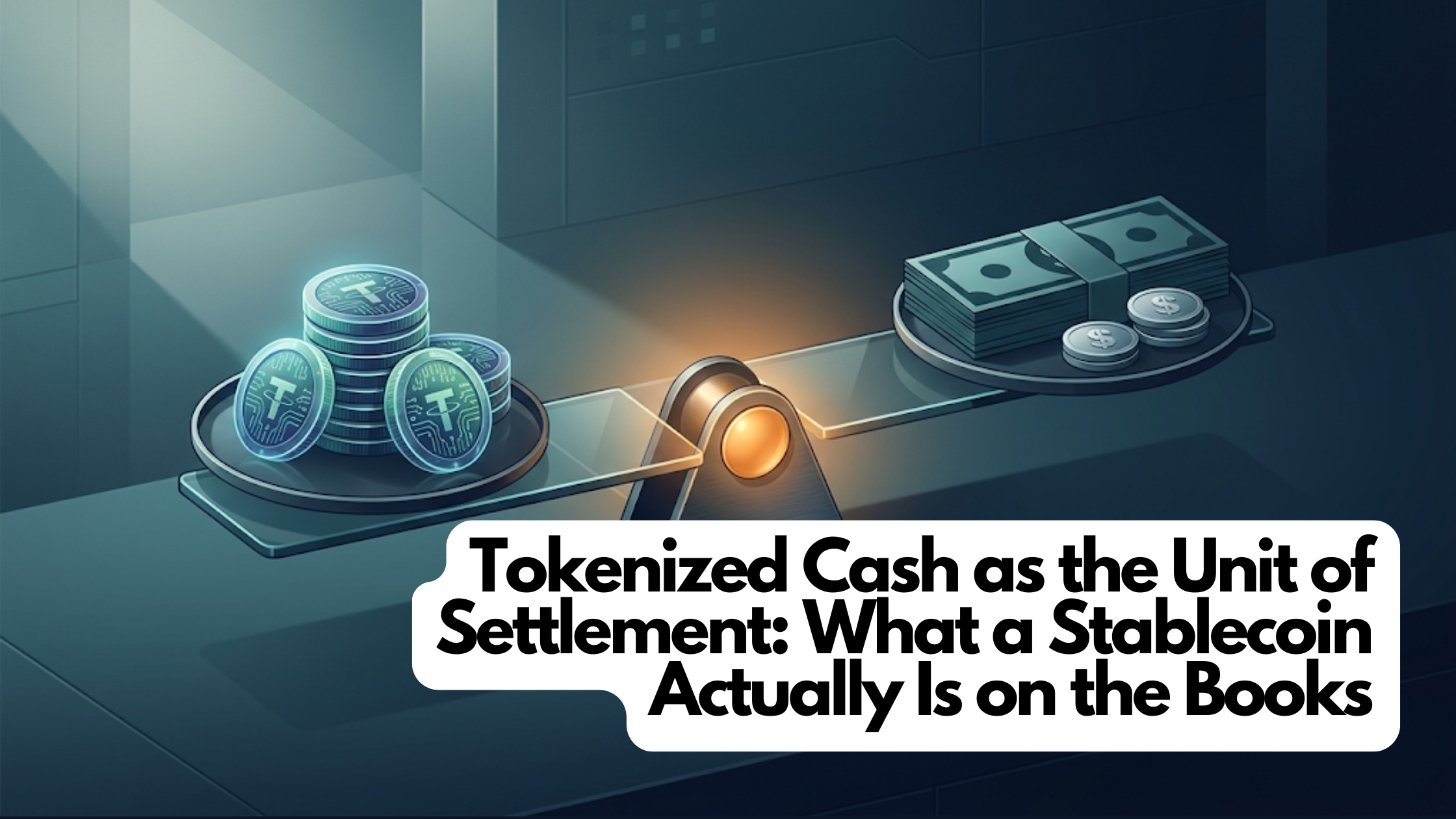
A reserve-backed stablecoin — USDC, issued by the regulated firm Circle, is the most common reference — is tokenized cash: a digital bearer-style instrument on a public blockchain, intended to always be redeemable for one dollar. Structurally it is analogous to e-money backed by a conservative reserve: the issuer creates a coin when a real dollar arrives, holds reserves against outstanding coins (typically cash and short-dated US government debt), and burns the coin on redemption. Reputable issuers publish regular third-party attestations confirming the reserves exist and match supply.

Note the careful word: analogous. A stablecoin is not, by that fact, a regulated e-money instrument or a fund — its legal classification is unsettled and varies by jurisdiction, and this briefing makes no claim of regulatory equivalence. What it shares with those instruments is the structure: a redeemable claim backed by a reserve, whose price is pinned by that redeemability.

The peg mechanics are worth stating plainly, because they are what a risk officer actually underwrites. The anchor is arbitrage against redemption. If the token trades at 99 cents on an exchange while remaining redeemable for a full dollar, arbitrageurs buy the cheap token and redeem it for par, and that buying pressure pushes the market price back toward a dollar. The peg holds because redemption is credible. Which means the peg is exactly as strong as the reserve behind it and the redemption channel in front of it — and no stronger.

Two properties change everything else. First, settlement is near-instant, final, and continuous — no T+2, no business hours, no operator queue. That is a genuine operational upgrade for a payments or escrow application: the moment the transfer confirms, value has moved and cannot be clawed back. Second, it is programmable — it can be escrowed by code, released against conditions, and settled inside an application without a bank in the loop. For a real-money app, those two properties are the entire reason to settle in a stablecoin rather than in a volatile crypto asset (whose price won’t sit still) or in bank rails (which can’t ride the same programmable settlement layer).

Where it genuinely differs

Better. Continuous, near-instant, final settlement; native programmability; global reach without correspondent-banking friction; a transparent, publicly auditable supply. For escrow and cross-border use, these are real advantages over multi-day, business-hours rails.

Worse or different. No deposit insurance and no chargeback: settlement is final the way cash is final, so an error or a payment to the wrong address has no reversal mechanism. You take issuer credit and reserve risk directly — the token is a claim on the issuer’s reserve management, not on an insured bank. And you inherit the peg’s failure mode: it is maintained, not guaranteed.

Risk and controls

  • Issuer and reserve risk. The token is only as good as the reserve behind it and the issuer running it. Favor issuers with conservative, transparent reserves (cash and short-dated government paper), regular attestations from credible auditors, and clear redemption rights. Treat the attestation cadence and reserve composition as ongoing diligence, not a one-time check. Avoid algorithmic designs that attempt to hold a peg through trading mechanics rather than real reserves — several have collapsed, and the label “stablecoin” alone guarantees nothing.
  • De-peg risk. In stressed markets a fully-reserved stablecoin can briefly trade below a dollar; the notable historical episodes tied to reserve concentration have generally recovered, but “generally recovered” is not “cannot fail.” Size exposure and concentration accordingly, and monitor the peg the way you would monitor a money-market fund’s shadow price.
  • Settlement-finality and operational risk. Irreversibility raises the stakes on payment operations: address verification, transaction review, and the custody controls covered elsewhere in this series matter more, not less, than on a reversible rail. There is no back office to unwind a mistake.
  • Custody and counterparty risk. How the token is held (self-custody versus a third party) reintroduces custody risk on top of issuer risk — two distinct layers to assess separately.
  • Compliance risk. Transfers are pseudonymous but permanently public. Sanctions screening and applicable AML obligations — including travel-rule considerations where they apply — remain fully in force; the rail’s transparency is a tool here, not an exemption. Regulatory classification of stablecoins is evolving and jurisdiction-specific.

How FairWins approaches this

FairWins uses stablecoins as its unit of settlement precisely for the reasons above: a stake, a group pot, or a payment is denominated and settled in a dollar-pegged token, so every figure a member sees is a plain dollar amount rather than “whatever this coin is worth on payout day.” The platform deliberately handles only a short, vetted list of reserve-backed, dollar-pegged tokens — not volatile assets — so the amount agreed is the amount that changes hands. Escrowed stakes are held in stablecoins and payouts arrive in stablecoins, with the finality that makes a code-held escrow trustworthy: once resolved, the winner can claim and no one can strand the funds. Movements pass the same sanctions and membership checks as any other action, on-chain transparency notwithstanding. And where any fee applies, FairWins discloses the exact cost, in dollars, before a member approves — the settlement asset’s transparency extended to the platform’s own economics. (The core wager escrow itself is denominated and settled in these tokens; it is not a yield product, and no return is implied by holding a stake.)

The honest summary for this reader: a reserve-backed stablecoin is structurally analogous to conservatively-backed tokenized cash, with settlement properties that genuinely beat traditional rails, in exchange for taking issuer, reserve, and finality risk directly and giving up insurance and reversibility. It is the right unit of settlement for a real-money application because of those trade-offs, not in spite of your needing to understand them.

This is educational information for finance professionals, not investment, legal, tax, or regulatory advice. Stablecoins carry issuer, reserve, de-peg, and operational risk; a peg is maintained, not guaranteed, and regulatory treatment varies by jurisdiction and is evolving. Assess any settlement asset against your own risk framework.

Related deep-dive

For the engineering details, see The Wager Lifecycle: How a Handshake Bet Becomes a Payout Nobody Can Strand.

Further reading

Custody Without a Custodian: Rethinking Safekeeping When Nobody Holds Your Assets

What self-custody actually changes about segregation, insolvency remoteness, and operational responsibility — and how passkey-based smart accounts turn a scary phrase into a controls story

SeriesFinance Professional Series
TrackCustody & Settlement
LevelIntermediate
AudienceTreasury and operations leads, custody and fund-ops specialists, compliance and risk officers, allocators
Tagscustody, self-custody, segregation, insolvency-remoteness, operational-risk, smart-accounts
Reading time~8 minutes

The question a custody review is supposed to answer

Every custody due-diligence checklist, whatever its length, is really trying to answer three questions. Are the assets segregated from the custodian’s own balance sheet? Are they insolvency-remote — safe if the custodian fails? And who bears the operational burden of keys, reconciliation, and access control? A qualified custodian exists precisely so that a professional can answer “yes, yes, them” and move on.

Self-custody breaks that shorthand. There is no third party holding the asset, no omnibus account, no custodial agreement to paper. For a finance professional, the instinct is unease: if nobody is the custodian, who is accountable? The honest answer is that self-custody does not remove the three questions — it relocates them. Segregation becomes structural rather than contractual. Insolvency remoteness becomes near-absolute rather than negotiated. And operational responsibility, which a custodian used to absorb, comes home to the asset owner. Whether that trade is attractive depends entirely on the quality of the controls that replace the custodian. That is the subject worth examining closely.

The traditional model: a custodian as intermediary and shock absorber

In the traditional world, a qualified custodian is both a safekeeping agent and a legal firewall. Client assets are held in segregated accounts, recorded as belonging to the client rather than the custodian, and — where the structure is sound — placed beyond the reach of the custodian’s creditors if it fails. Layered on top are the operational services you are really paying for: reconciliation, access controls, dual authorization, insured vaults, audited processes (often evidenced by a SOC 2 report, an independent attestation of a service organization’s controls), and a claims path when something goes wrong.

Those benefits are real, and so are the frictions. Assets sit inside someone else’s balance sheet and legal perimeter. Segregation is only as good as the paperwork and the jurisdiction’s insolvency law. Access is gated by the custodian’s hours, systems, and risk appetite. And the arrangement introduces the very thing custody is meant to reduce elsewhere — a concentrated counterparty whose failure, freeze, or error becomes your problem. History offers enough examples of client assets caught in a failed intermediary to make the point without belaboring it.

What changes on-chain: the asset never enters a balance sheet

Self-custody on a public blockchain rearranges the picture at the root. A stablecoin such as USDC held in a self-custodial account is recorded on the network as belonging to that account’s address. It is not on FairWins’ balance sheet, not in an omnibus pool, and not subject to any transfer that the account’s own keys do not authorize. Segregation stops being a promise in a custody agreement and becomes a property of where the asset lives: one address, one owner, no commingling by construction.

Insolvency remoteness follows from the same fact. If Chipprbots — the software provider — were to disappear tomorrow, the assets would not be entangled in its estate, because they were never in its possession. There is no omnibus account to unwind, no creditor claim to litigate, no administrator deciding the order of the queue. The network keeps running; the keys keep working. That is a materially stronger form of insolvency remoteness than most custodial structures can offer, and it is worth stating plainly because it is one of the genuine advantages.

What does not vanish is operational responsibility. Someone must hold the keys, control access, and make sure the right people — and only the right people — can move funds. In a custodial model, the custodian’s operations team does this. In self-custody, it is you. This is where most of the traditional custody value actually sat, and it is the part self-custody hands back to the owner. The interesting question is therefore not “is self-custody safer?” but “can the key-management and access controls be made institution-grade?”

Passkey-based smart accounts as a controls story

This is where the account design matters more than the custody label. A FairWins account is not a private key written on paper. It is a small program on the blockchain — a smart account — whose authority to move funds is defined by a list of owners and a set of rules the account itself enforces. The controls a treasurer cares about are expressed in that program rather than in a service-level agreement.

Start with the keys. Each owner can be a passkey — the same hardware-backed, biometric credential (WebAuthn, the standard behind Face ID and fingerprint sign-in) that already protects enterprise logins and payments. The private key is generated inside a tamper-resistant chip, never leaves the device, and will only sign after a biometric check. It cannot be exported, emailed, or pasted into a fake support chat. Compared with a seed phrase on paper — the classic self-custody failure mode — this is a categorical improvement in the operational risk that most worries a controls reviewer: key exfiltration and social engineering.

Now the access model. Ownership of the account is a list, not a single secret. That list can hold more than one credential, and the account refuses to remove its last owner, so it cannot lock itself out. This is the on-chain analogue of controls a treasury team already runs: no single point of failure, redundant signers, and a recovery path that does not depend on one fragile artifact. For higher-value balances, the same building blocks extend to multi-signature arrangements, where several independent approvals are required before funds move — structurally similar to the dual-authorization and quorum controls you would demand of any corporate treasury account, but enforced by code rather than by a bank’s back office.

Two further properties are worth a risk officer’s attention. First, upgrades to the account’s logic can only be authorized by the account’s own owners; the software provider holds no override switch over anyone’s funds. That is what makes this self-custody without scare quotes — nobody but the owner can move or freeze the owner’s assets. Second, because the rules live in an open, auditable program deployed identically across networks, the control environment is inspectable in a way a proprietary custodial black box is not.

Risk and controls: an honest ledger

Self-custody removes custodian counterparty risk and delivers strong segregation and insolvency remoteness. In exchange, it concentrates a different risk set that a professional must own explicitly.

  • Key and access risk. There is no custodian help desk and, for on-chain transfers, no reversal. Passkeys and multi-owner accounts sharply reduce the classic loss modes, but device loss, recovery design, and owner-list governance now sit inside your control framework, not a vendor’s. Recovery must be planned before it is needed, not after.
  • Operational and process risk. Reconciliation, authorization workflows, and segregation of duties do not disappear; they move in-house. The upside is that on-chain balances are continuously and independently verifiable against the public ledger — a stronger reconciliation primitive than a custodial statement — but someone has to run the process.
  • Smart-contract risk. The account is code, and code can carry bugs. FairWins’ mitigation is to build on a widely deployed, professionally audited smart-account design and adopt it unmodified, so external audits keep applying, rather than forking it into something un-reviewed. Reused audited components are a control; bespoke unaudited ones are a risk.
  • Compliance and classification risk. Self-custody does not change your KYC/AML, sanctions-screening, or record-keeping obligations, and the regulatory treatment of custody-technology arrangements varies by jurisdiction and is still evolving. Nothing here substitutes for your own legal and regulatory analysis.

The through-line: self-custody is not the absence of controls. It is a different placement of controls, and passkey-based smart accounts are what make that placement defensible to an institutional reviewer.

How FairWins approaches this

FairWins never takes custody of user funds. Assets sit in self-custodial smart accounts controlled by passkeys, with multi-owner and multi-signature options for higher-value balances, upgrade authority that belongs solely to the account owner, and audited, unmodified account logic underneath. Operational responsibilities that a custodian would traditionally absorb are handed back to the owner deliberately — and the account design exists to make carrying them realistic rather than reckless.

This briefing is educational and informational only. It is not investment, legal, tax, custody, or regulatory advice. Custody arrangements and their regulatory treatment vary by jurisdiction and are evolving; assess your own obligations with qualified advisors before acting.

Related deep-dive

For the engineering details, see Passkey Smart Accounts.

Further reading