What Is DeFi Lending, and Where Does the Yield Come From?

Lending out money you’re not using, without a bank in the middle — and an honest look at what pays the interest

SeriesKnowledge Base
TrackEarning & Yield
LevelBeginner–Intermediate
AudienceCurious beginners who have used a bank app but never DeFi
Tagslending, yield, defi, interest, savings
Reading time~6 minutes

The money that just sits there

Think about the cash in your checking account. Between paydays and payments, some of it just sits there doing nothing. Your bank, quietly, does not let it sit — it lends your deposit to other people (mortgages, car loans, business loans), collects interest from them, and hands you back a sliver of that interest as your “savings rate.” The bank keeps the rest.

That arrangement is centuries old, and it works. But it has a catch: you have to trust the bank completely. You can’t see where your money went, you can’t choose the terms, and the bank is the one deciding how much of the earnings you get to keep.

DeFi lending is the same basic idea — lending out idle money to earn interest — rebuilt so that no single company sits in the middle holding your funds. “DeFi” is short for decentralized finance: financial services that run as open software on a blockchain instead of inside one company’s private computers.

What DeFi lending actually is

In plain terms: DeFi lending lets you lend your idle digital dollars to borrowers directly, through open software, and collect the interest they pay — most of it, not a sliver.

The “digital dollars” here are usually a stablecoin — a crypto token designed to stay worth one real dollar, like USDC. You deposit some stablecoins into a shared lending pool. Borrowers take loans out of that pool and pay interest. That interest flows back to everyone who deposited, in proportion to how much they put in. There’s no bank branch, no loan officer, and no company quietly keeping the difference — the rules are just software that everyone can inspect.

Where the yield actually comes from

This is the most important question to ask about any place that promises to grow your money, so let’s be blunt about it.

The yield comes from borrowers paying interest. That’s it. Someone on the other side wants to borrow those digital dollars and is willing to pay to do it, and that payment is your return. It is not magic, it is not “the blockchain printing money,” and it is not a company subsidizing you out of goodwill.

Why would anyone borrow? Often to trade, to avoid selling an asset they want to keep, or to fund a business — the same reasons people borrow in the ordinary economy. And crucially, in well-built DeFi lending, borrowers must post collateral worth more than they borrow. If someone wants to borrow $1,000, they might lock up $1,500 of another asset first. If they don’t pay it back, that collateral is sold automatically to cover the loan. This “over-collateralization” is what protects the pool — and, indirectly, you.

When you understand that yield is just borrower interest, a useful instinct follows: if a return seems far too high, ask who is paying it and why. A healthy answer names real borrowers paying real rates. A suspicious one can’t.

How it differs from a savings account

A bank savings account and a DeFi lending pool rhyme, but the differences matter:

  • Who holds your money. In a bank, the bank holds it. In DeFi lending, your funds sit in open software you can withdraw from directly — nobody has to approve it for you.
  • Who guarantees it. Bank deposits (up to a limit) are often backed by government insurance. DeFi deposits are not. There is no FDIC here. If something breaks, there’s no agency that makes you whole.
  • How the rate is set. A bank sets your savings rate by policy. A DeFi rate floats with supply and demand — more borrowers means higher rates, fewer means lower. It changes constantly.
  • How much of the earnings you keep. Because there’s no bank keeping the spread, more of the borrower interest reaches you.

That trade is the whole story: you give up the safety net and the hand-holding, and in exchange you get transparency, control, and usually more of the yield. Neither is “better” in the abstract — they’re different deals.

How it shows up in FairWins

FairWins has an Earn section that does exactly this. If you’re holding stablecoins between wagers, you can lend them out through Morpho — a well-established lending protocol — and earn a return over time. The money goes straight from your own wallet into the lending pool; FairWins never holds it, and you can withdraw whenever you like. FairWins charges no fee on Earn, and — as with everything on the platform — you always see the exact cost of any action before you approve it. The estimated rate is shown right on each pool, clearly labeled as an estimate, not a promise.

What to watch out for

  • Yield is never guaranteed. The rate you see is an estimate based on today’s conditions. It will move, and it can fall.
  • There’s no insurance. DeFi lending carries real risks — the software could have a flaw, or extreme market conditions could cause losses. Only lend what you could afford to have at risk.
  • “Too good to be true” usually is. A sky-high rate with no clear borrower paying for it is a red flag, not an opportunity.

Lending idle money to earn interest is one of the oldest ideas in finance. DeFi just lets you do it without handing the keys to a bank — which is powerful, and which is also why the responsibility comes back to you.

Related deep-dive

Want the engineering details? Read Earn Without Surprises: Putting Idle Funds to Work, With a Fee You Can See.

Learn more

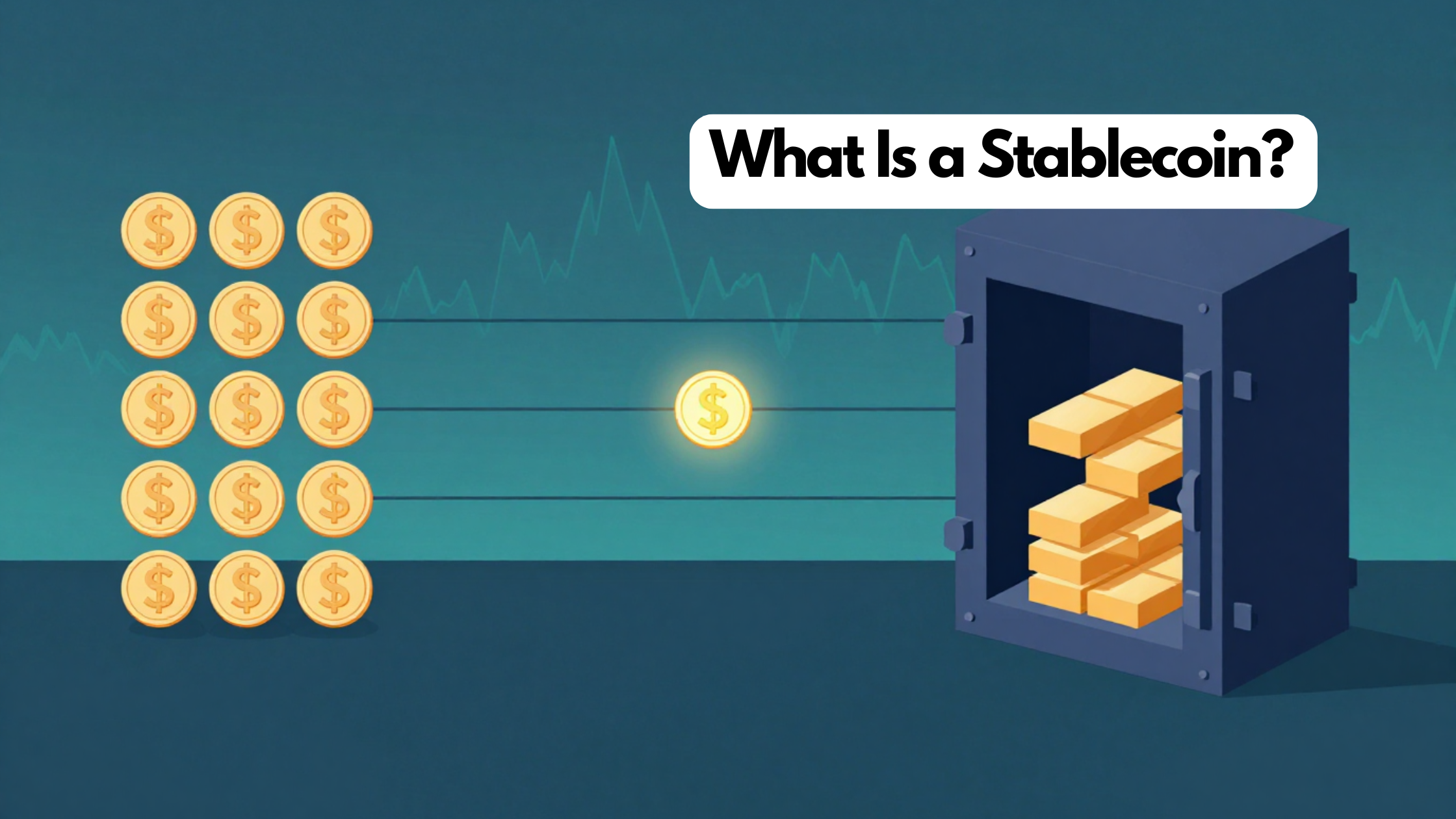
What Is a Stablecoin?

Why a dollar-shaped digital coin makes real-money apps possible — and how it actually stays worth about a dollar


SeriesKnowledge Base
TrackPayments & Markets
LevelBeginner
AudienceCrypto-curious beginners — no technical background needed
Tagsstablecoins, usdc, payments, how-it-works
Reading time~5 minutes

The price-tag problem

Imagine you agreed to split dinner with a friend, and by the time the bill came, the value of the money in your wallet had jumped or dropped 8%. You’d never know what a fair share was. That is roughly what it feels like to use a typical cryptocurrency — like Bitcoin or Ether — for everyday amounts. The technology is fine; the price just won’t sit still.

For a lot of what crypto promises — sending money to a friend, holding a shared pot, settling a bet — that wobble is a dealbreaker. You want the digital dollar in your app to be worth a dollar tomorrow, the same way the balance in your bank app is. That is exactly the gap a stablecoin fills.

What it is

A stablecoin is a digital coin designed to hold a steady value, almost always one US dollar. It lives on a blockchain — a shared public ledger that many computers keep in sync — so it moves with the speed and openness of crypto, but it’s meant to behave like cash.

The one you’ll meet most often is USDC, issued by a regulated company called Circle. One USDC is intended to always be redeemable for one real US dollar. There are others (USDT, and dollar-pegged coins from various issuers), but USDC is the default across FairWins because it’s transparent and widely trusted.

Think of it as a digital gift card denominated in dollars that you can freely send to anyone, spend, or cash back out — not a lottery ticket whose value swings around.

Why it exists

Money apps need a stable unit. If you escrow a stake, hold a group pot, or pay someone across the world, every party needs to agree on what the amount is. Regular bank dollars can’t travel on a blockchain, and volatile crypto can’t hold a steady price. A stablecoin is the bridge: dollar-priced like your bank balance, but programmable and portable like crypto.

That’s why nearly every serious “real-money” crypto app settles in stablecoins rather than in Bitcoin or Ether. It’s the difference between a bet for “200 dollars” and a bet for “however much this coin happens to be worth on payout day.”

How it stays at about a dollar

A well-run stablecoin like USDC keeps its value through a simple, boring, and reassuring idea: every coin is backed by a real dollar (or a safe dollar-equivalent, like short-term US government debt) held in reserve.

Picture a coat check. For every coat handed in, the attendant issues exactly one ticket. Anyone holding a ticket can always walk up and get a coat back. Because the tickets are always redeemable one-for-one, a ticket is never worth more or less than a coat. USDC works the same way: Circle issues a coin only when a real dollar comes in, and burns the coin when someone cashes out. Reputable issuers publish regular reports from outside accountants confirming the reserves are really there.

That redeemability is what pins the price. If a coin ever drifted to 98 cents on an exchange, traders would happily buy it and redeem it for a full dollar, pocketing the difference — and that buying pressure pushes the price right back to a dollar. The promise of “always worth one real dollar on demand” is the anchor.

How it shows up in FairWins

In FairWins, stablecoins are simply the money. When you place a wager, join a group pool, or send funds to a friend, the amount is denominated and settled in a stablecoin like USDC, so every number you see is a plain dollar amount. Stakes held in escrow are held in stablecoins; payouts arrive in stablecoins. FairWins only ever handles a short, vetted list of these dollar-pegged tokens — not volatile coins — precisely so the amount you agreed to is the amount that changes hands.

Whenever a fee applies, FairWins shows you the exact cost, in dollars, before you approve anything.

What to watch out for

Stablecoins are steadier than other crypto, but “stable” isn’t “risk-free.” A few honest caveats:

  • It’s only as good as its backing. A stablecoin’s promise depends on the issuer actually holding the reserves. This is why the quality of the issuer matters, and why transparent, regulated coins like USDC are preferred over obscure ones.
  • Rare “de-peg” moments. In stressful markets a stablecoin can briefly trade slightly below a dollar. Fully-reserved coins have generally recovered, but it’s a reminder that the peg is maintained, not magic.
  • Avoid the algorithmic kind. Some past “stablecoins” tried to hold their price with clever code and trading tricks instead of real reserves. Several collapsed dramatically. Reserve-backed coins like USDC are a different, sturdier design — but the word “stablecoin” alone doesn’t guarantee safety.
  • You’re moving real money. A stablecoin transfer is final, like handing over cash. Double-check amounts and recipients.

For everyday use inside a well-designed app, though, a reserve-backed stablecoin does exactly what you want: it keeps a dollar looking and acting like a dollar.

Related deep-dive

Want the engineering details? Read The Wager Lifecycle: How a Handshake Bet Becomes a Payout Nobody Can Strand.

Learn more