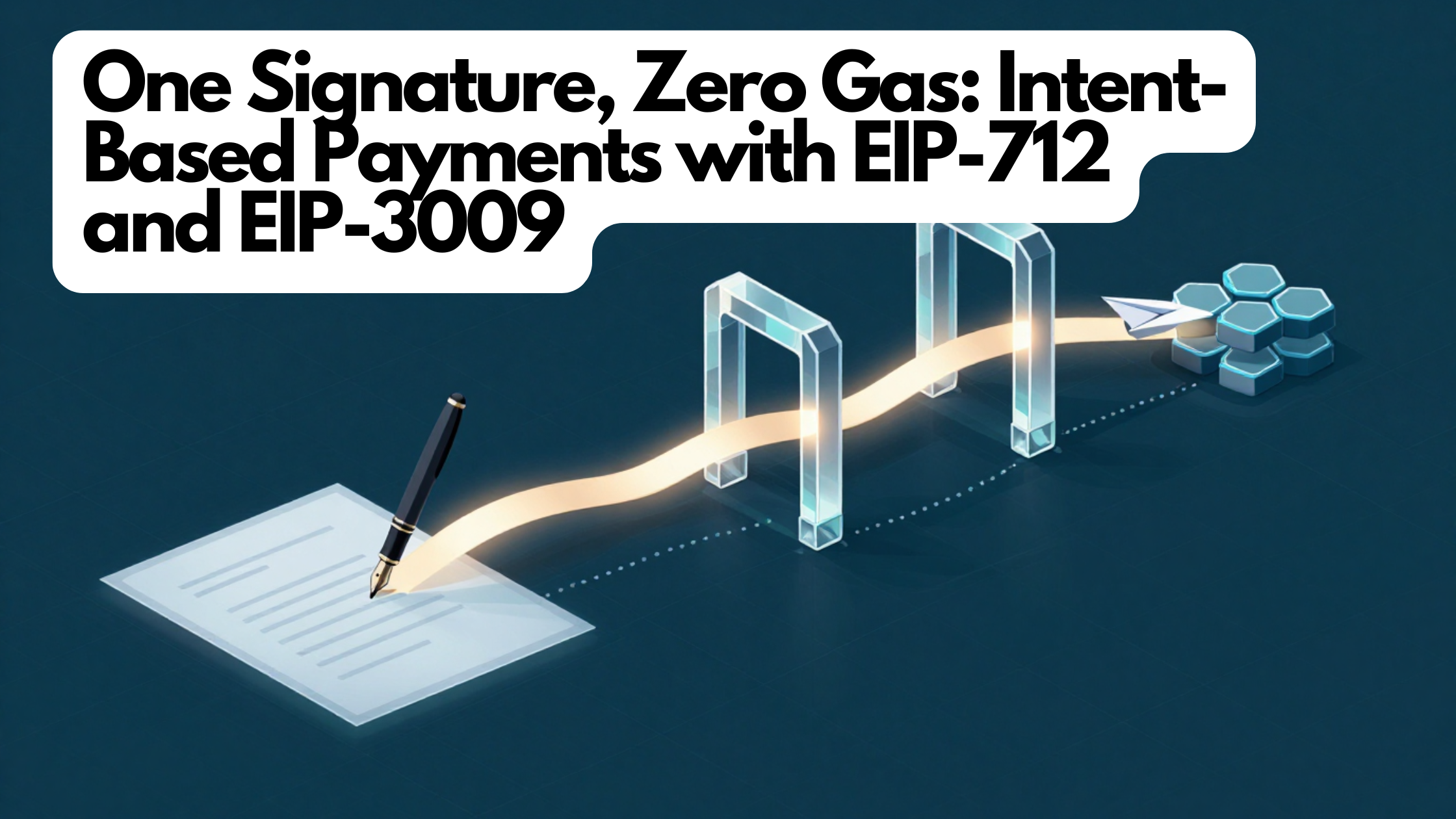
One Signature, Zero Gas: How Gasless Payments Actually Work

How FairWins turned every action into a signed “intent” — you sign what you want, and someone else pays the fee to submit it

The Stranded User

A user wins a wager on FairWins. Fifty USDC sits in escrow with their address recorded as the winner. All they have to do is claim it. One problem: their wallet holds exactly zero of Polygon’s native coin — the token every transaction needs to pay its network fee, its “gas.” They funded their wallet with USDC from an exchange, never touched the native token, and have no intention of learning what a gas station is. Their money is on-chain, provably theirs, and completely out of reach.

The old flow was worse than one stuck action. Just creating a wager took two transactions: a step to authorize the platform to move your stablecoin, then the step that actually creates the wager. Accepting one meant the same dance. Every step needed native gas, and the failure mode was plain: a user who holds only the stablecoin can’t act at all.

The cruelest version is lopsided — a user who scraped together enough gas to place a bet but can’t afford the gas to claim their winnings. Money in, no money out. Any gasless design that fixes deposits but not withdrawals has built a lobster trap.

The fix is to make the entire platform run on signed intents. Instead of sending a transaction and paying the fee, the user signs a message — for free, no gas — describing exactly what they want to do. Anyone can then carry that signed message onto the blockchain and pay the fee to submit it. Crucially, the on-chain effect is always credited to the person who signed it, never to whoever submitted it. One signature replaces the whole authorize-then-act dance, and a helper service — a “relayer” — pays the fee.

What an Intent Actually Is

An intent is a structured, human-readable message the user signs with their wallet, built on EIP-712 — a widely used standard for signable data a wallet can display in plain terms, so you see the actual stake, deadline, and counterparty, not a wall of hex. Every action on the platform has its own intent: create a wager, accept one, claim a payout, declare a draw, buy a membership tier, and so on.

Each intent locks down three things:

  1. Who is acting — a named field that must match whoever actually signed. You can’t sign on someone else’s behalf.
  2. Every detail of the action — stake amounts, deadlines, which wager. Nothing is left blank for the submitter to fill in later.
  3. A replay guard and an expiry — a random one-time code so the same intent can’t be reused, plus a window so a stale intent eventually expires.

Signatures are checked under a fingerprint unique to each contract and each network, so a signed intent is valid on exactly one contract on exactly one blockchain — a one-time code used up on one contract can never be replayed on another. The check also accepts signatures from smart-contract wallets, so FairWins’ passkey wallets can sign intents too. A failed intent never uses up its one-time code; a successful one can never run twice.

Paying With a Signature, Not a Gas Balance

Signing an action is the easy half. The hard half is money-in actions. The intent says “stake 50 USDC” — but the platform still has to pull 50 USDC out of the wallet, which normally needs a separate, gas-paying authorization first.

This is what EIP-3009 is for — a feature built into Circle’s USDC that lets a holder authorize a specific payment purely by signing. The user signs an authorization naming who gets paid, how much, and a validity window; the receiving contract presents that signature to the USDC token, and the transfer happens. No standing “allowance” ever exists, and no separate transaction is needed.

So a money-in intent carries two signatures: the FairWins intent (“accept wager 41”) and the USDC payment authorization (“pay 50 USDC”). Which raises the attack that shapes the whole design: what stops the submitter from mixing and matching? Could they staple your payment authorization to a different action, or pair your accept-intent with a payment meant for something else?

They can’t, because the two signatures are cryptographically stapled together. The intent you sign references the exact payment it’s meant to travel with, and the contract refuses to proceed unless the payment matches — same amount, same one-time code — the one you committed to. The USDC token adds the final lock: the payment can only land in the contract that’s asking. The net result: a submitter can refuse to carry your intent, but can never substitute, redirect, or resize the payment.

Two Twins, Identical Rules

Every gasless action is a twin of an ordinary one. Accepting a wager the normal way and accepting it via a signed intent run the exact same checks against the person acting — sanctions screening, membership gating, ownership, account freezes. The only difference is how the acting identity is established: from the sender on the direct path, from the recovered signature on the intent path. The submitter’s own standing is never consulted, and because both twins run the same underlying action, they can’t quietly drift apart.

Keeping Three Codebases in Perfect Sync

Here’s the lesson most write-ups skip. The exact shape of each intent has to be defined in three separate places: the smart contract that verifies it, the app that helps the user sign it, and the relayer service that handles it.

These three definitions must be byte-identical — not just similar in spirit. The signing standard fingerprints the entire structure, so a single reordered field, or a field’s type written slightly differently, produces a completely different fingerprint and a signature that verifies to a random, wrong address. The failure is silent when you build it and total when a real user tries: every signature rejected, every time.

The discipline FairWins landed on treats the deployed contract as authoritative, and every other copy documents exactly where it matches. New intents ship in all three places at once, with cross-references so no one edits one and forgets the others. It’s unglamorous bookkeeping, and it’s the entire difference between a working gasless system and a flood of mysterious support tickets.

Never Stranded

The final rule is architectural humility: the relayer is optional, and the design has to survive without it. Every gasless flow keeps a pay-your-own-gas fallback — the original path is never removed. The app enforces this at the wiring level: a screen literally can’t ship a gasless-only dead end, because the code refuses to build one. If the relayer is switched off, overloaded, rate-limiting, or timing out, the app quietly falls back to the user paying their own gas, and the on-chain result is identical.

The fallback also covers networks where the signature-based payment simply doesn’t exist — one test network’s stablecoin lacks it entirely, so the app detects the gap before opening the signing prompt and uses the normal path. And status is honest end to end: the interface never shows “confirmed” before a transaction is actually mined. Signed, pending, confirmed, expired, and failed are all distinct, truthful states.

Design Decisions

Random one-time codes, not a counter. Each intent’s replay guard is a random value, usable in any order. A counter would force a user’s actions into strict sequence and let one stuck intent block everything behind it; random codes let someone sign three intents and have them land in any order. Cancellation is precise — a user can kill one specific unsubmitted intent, and even that can be gasless.

Sign everything, trust nothing. Every detail the action uses is inside the signed message. The alternative — signing a compact code that stands for details delivered separately — is fewer bytes but shows the user nothing legible to approve. Human-readable signed data means the wallet displays the real stake, deadline, and counterparty.

Fee recovery is bounded and segregated. An optional second payment authorization lets the platform recover its gas cost in USDC, but it’s capped on-chain, settles in the same transaction as the action, and pays into a segregated account — never the relayer’s own wallet. A compromised relayer gains no power to skim fees.

Censorship is the accepted residual risk. A relayer can decline to submit an intent; it cannot forge, alter, or replay one. And because the pay-your-own-gas path always exists, refusal degrades to mere inconvenience. That trade — accept the possibility of censorship, eliminate any custody of user funds — is the entire design in one sentence.


Note: FairWins wagers are peer-to-peer agreements based on publicly available information and legitimate forecasting. Gasless submission changes who pays the transaction fee, not who is accountable: every intent is credited to its signer, who remains fully subject to applicable law and the platform’s compliance screening.

Further reading

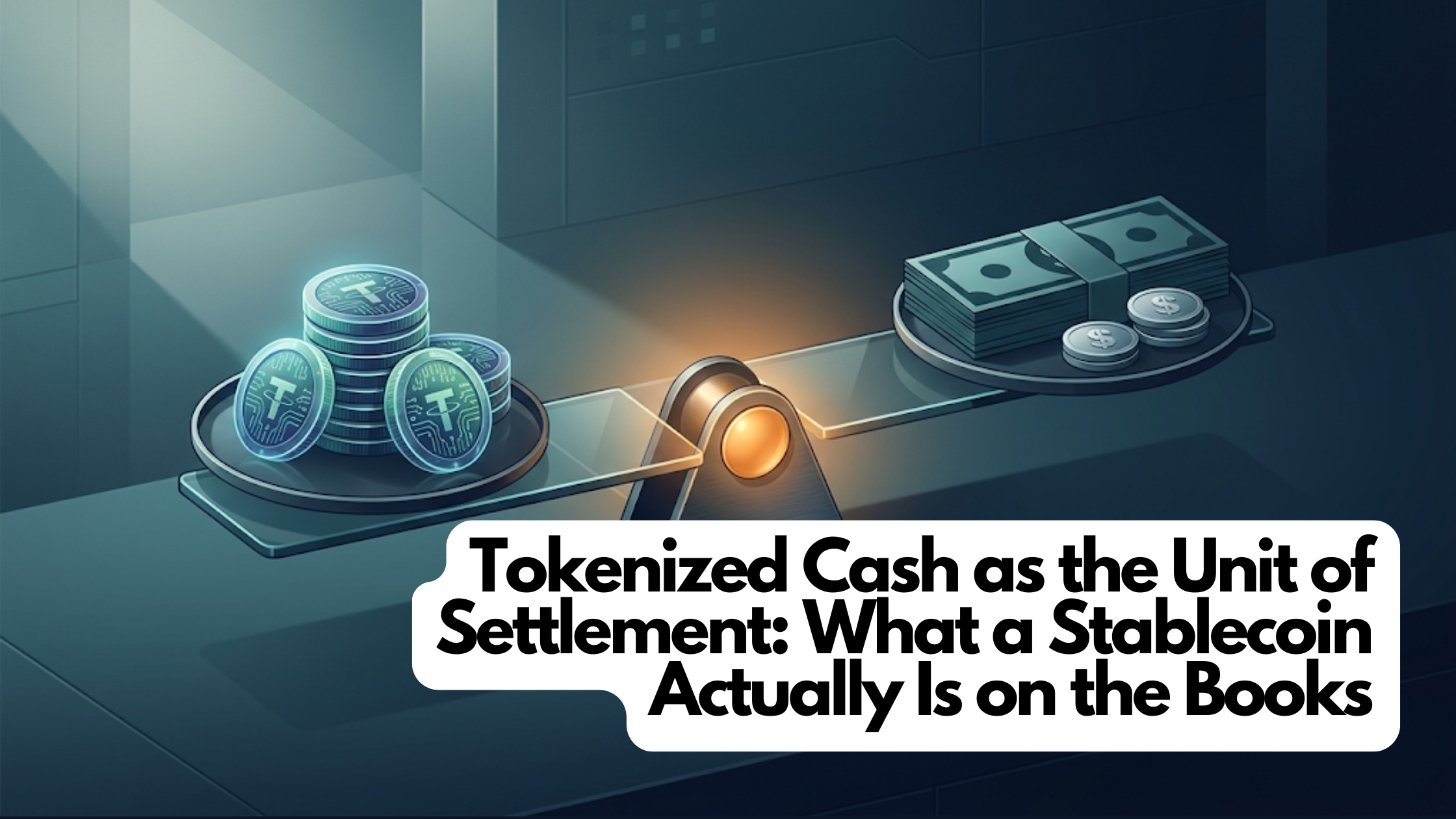
Tokenized Cash as the Unit of Settlement: What a Stablecoin Actually Is on the Books

Stablecoins versus e-money and bank deposits, peg mechanics and reserve attestation, and why an app settles in them — with an honest read on de-peg and issuer risk


SeriesFinance Professional Series
TrackMoney, Yield & Markets
LevelIntermediate
AudienceTreasury and payments leads, product managers, risk and compliance officers, allocators
Tagsstablecoins, settlement-asset, tokenized-cash, e-money, payments
Reading time~8 minutes

Which dollar is it, exactly?

When an app tells you a balance is “200 dollars,” a finance professional’s next question is the right one: a claim on what, held by whom, redeemable how? A bank deposit is an unsecured claim on a commercial bank, insured to a limit, settling through the banking system. E-money is a claim on a licensed issuer that must hold safeguarded funds against it. A money-market fund share is a claim on a pool of short-dated instruments, redeemable at (or very near) par. These are different instruments with different risk, different settlement, and different legal treatment — even though each reads as a dollar on a screen.

A dollar-pegged stablecoin is another such instrument, and the point of this briefing is to place it precisely among the ones you already know: what it structurally resembles, where the analogy breaks, and why an application would choose it as its unit of settlement despite carrying risks a bank deposit does not.

The traditional model: how “cash” settles today

In conventional finance, the settlement asset varies by rail. Retail payments settle across bank deposits and card networks; wholesale settles in central-bank reserves; securities settle delivery-versus-payment through infrastructures that exchange the asset and the cash simultaneously to eliminate principal risk. Each rail has an operator, a settlement window (often T+1 or T+2), business hours, and a legal framework governing finality and reversal.

E-money regimes and money-market funds are the closest reference points for what a stablecoin is trying to be. E-money is prepaid value: you hand a licensed issuer fiat, they issue redeemable digital value one-for-one, and regulation requires the fiat be safeguarded — segregated, held in secure assets — so it is there when you redeem. A money-market fund takes cash, holds short-term government and high-quality paper, and lets you redeem shares at approximately par on demand. Both are “dollar-shaped claims backed by conservative assets, redeemable near par.” Hold that thought.

What changes with a stablecoin

A reserve-backed stablecoin — USDC, issued by the regulated firm Circle, is the most common reference — is tokenized cash: a digital bearer-style instrument on a public blockchain, intended to always be redeemable for one dollar. Structurally it is analogous to e-money backed by a conservative reserve: the issuer creates a coin when a real dollar arrives, holds reserves against outstanding coins (typically cash and short-dated US government debt), and burns the coin on redemption. Reputable issuers publish regular third-party attestations confirming the reserves exist and match supply.

Note the careful word: analogous. A stablecoin is not, by that fact, a regulated e-money instrument or a fund — its legal classification is unsettled and varies by jurisdiction, and this briefing makes no claim of regulatory equivalence. What it shares with those instruments is the structure: a redeemable claim backed by a reserve, whose price is pinned by that redeemability.

The peg mechanics are worth stating plainly, because they are what a risk officer actually underwrites. The anchor is arbitrage against redemption. If the token trades at 99 cents on an exchange while remaining redeemable for a full dollar, arbitrageurs buy the cheap token and redeem it for par, and that buying pressure pushes the market price back toward a dollar. The peg holds because redemption is credible. Which means the peg is exactly as strong as the reserve behind it and the redemption channel in front of it — and no stronger.

Two properties change everything else. First, settlement is near-instant, final, and continuous — no T+2, no business hours, no operator queue. That is a genuine operational upgrade for a payments or escrow application: the moment the transfer confirms, value has moved and cannot be clawed back. Second, it is programmable — it can be escrowed by code, released against conditions, and settled inside an application without a bank in the loop. For a real-money app, those two properties are the entire reason to settle in a stablecoin rather than in a volatile crypto asset (whose price won’t sit still) or in bank rails (which can’t ride the same programmable settlement layer).

Where it genuinely differs

Better. Continuous, near-instant, final settlement; native programmability; global reach without correspondent-banking friction; a transparent, publicly auditable supply. For escrow and cross-border use, these are real advantages over multi-day, business-hours rails.

Worse or different. No deposit insurance and no chargeback: settlement is final the way cash is final, so an error or a payment to the wrong address has no reversal mechanism. You take issuer credit and reserve risk directly — the token is a claim on the issuer’s reserve management, not on an insured bank. And you inherit the peg’s failure mode: it is maintained, not guaranteed.

Risk and controls

  • Issuer and reserve risk. The token is only as good as the reserve behind it and the issuer running it. Favor issuers with conservative, transparent reserves (cash and short-dated government paper), regular attestations from credible auditors, and clear redemption rights. Treat the attestation cadence and reserve composition as ongoing diligence, not a one-time check. Avoid algorithmic designs that attempt to hold a peg through trading mechanics rather than real reserves — several have collapsed, and the label “stablecoin” alone guarantees nothing.
  • De-peg risk. In stressed markets a fully-reserved stablecoin can briefly trade below a dollar; the notable historical episodes tied to reserve concentration have generally recovered, but “generally recovered” is not “cannot fail.” Size exposure and concentration accordingly, and monitor the peg the way you would monitor a money-market fund’s shadow price.
  • Settlement-finality and operational risk. Irreversibility raises the stakes on payment operations: address verification, transaction review, and the custody controls covered elsewhere in this series matter more, not less, than on a reversible rail. There is no back office to unwind a mistake.
  • Custody and counterparty risk. How the token is held (self-custody versus a third party) reintroduces custody risk on top of issuer risk — two distinct layers to assess separately.
  • Compliance risk. Transfers are pseudonymous but permanently public. Sanctions screening and applicable AML obligations — including travel-rule considerations where they apply — remain fully in force; the rail’s transparency is a tool here, not an exemption. Regulatory classification of stablecoins is evolving and jurisdiction-specific.

How FairWins approaches this

FairWins uses stablecoins as its unit of settlement precisely for the reasons above: a stake, a group pot, or a payment is denominated and settled in a dollar-pegged token, so every figure a member sees is a plain dollar amount rather than “whatever this coin is worth on payout day.” The platform deliberately handles only a short, vetted list of reserve-backed, dollar-pegged tokens — not volatile assets — so the amount agreed is the amount that changes hands. Escrowed stakes are held in stablecoins and payouts arrive in stablecoins, with the finality that makes a code-held escrow trustworthy: once resolved, the winner can claim and no one can strand the funds. Movements pass the same sanctions and membership checks as any other action, on-chain transparency notwithstanding. And where any fee applies, FairWins discloses the exact cost, in dollars, before a member approves — the settlement asset’s transparency extended to the platform’s own economics. (The core wager escrow itself is denominated and settled in these tokens; it is not a yield product, and no return is implied by holding a stake.)

The honest summary for this reader: a reserve-backed stablecoin is structurally analogous to conservatively-backed tokenized cash, with settlement properties that genuinely beat traditional rails, in exchange for taking issuer, reserve, and finality risk directly and giving up insurance and reversibility. It is the right unit of settlement for a real-money application because of those trade-offs, not in spite of your needing to understand them.

This is educational information for finance professionals, not investment, legal, tax, or regulatory advice. Stablecoins carry issuer, reserve, de-peg, and operational risk; a peg is maintained, not guaranteed, and regulatory treatment varies by jurisdiction and is evolving. Assess any settlement asset against your own risk framework.

Related deep-dive

For the engineering details, see The Wager Lifecycle: How a Handshake Bet Becomes a Payout Nobody Can Strand.

Further reading

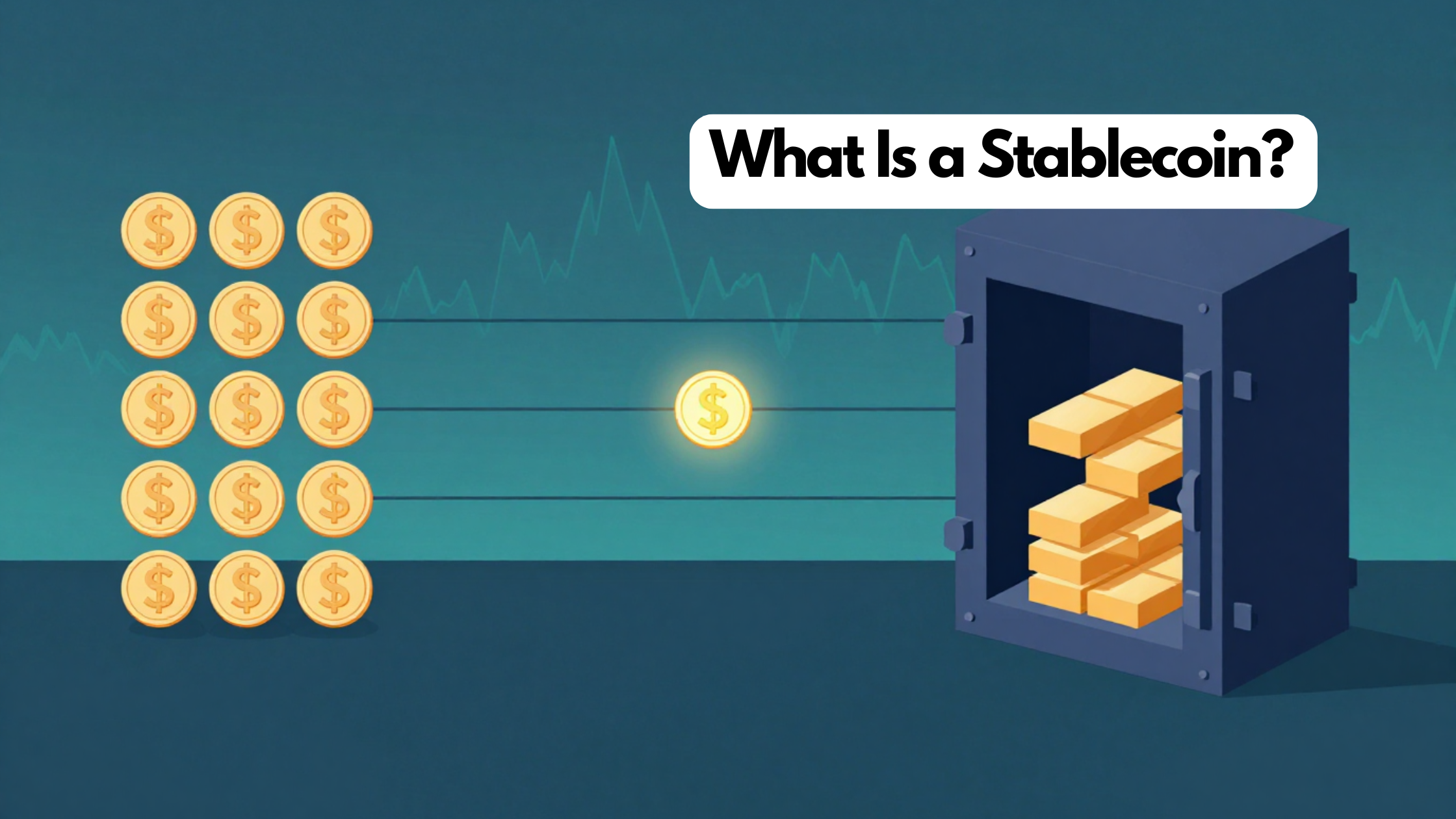
What Is a Stablecoin?

Why a dollar-shaped digital coin makes real-money apps possible — and how it actually stays worth about a dollar


SeriesKnowledge Base
TrackPayments & Markets
LevelBeginner
AudienceCrypto-curious beginners — no technical background needed
Tagsstablecoins, usdc, payments, how-it-works
Reading time~5 minutes

The price-tag problem

Imagine you agreed to split dinner with a friend, and by the time the bill came, the value of the money in your wallet had jumped or dropped 8%. You’d never know what a fair share was. That is roughly what it feels like to use a typical cryptocurrency — like Bitcoin or Ether — for everyday amounts. The technology is fine; the price just won’t sit still.

For a lot of what crypto promises — sending money to a friend, holding a shared pot, settling a bet — that wobble is a dealbreaker. You want the digital dollar in your app to be worth a dollar tomorrow, the same way the balance in your bank app is. That is exactly the gap a stablecoin fills.

What it is

A stablecoin is a digital coin designed to hold a steady value, almost always one US dollar. It lives on a blockchain — a shared public ledger that many computers keep in sync — so it moves with the speed and openness of crypto, but it’s meant to behave like cash.

The one you’ll meet most often is USDC, issued by a regulated company called Circle. One USDC is intended to always be redeemable for one real US dollar. There are others (USDT, and dollar-pegged coins from various issuers), but USDC is the default across FairWins because it’s transparent and widely trusted.

Think of it as a digital gift card denominated in dollars that you can freely send to anyone, spend, or cash back out — not a lottery ticket whose value swings around.

Why it exists

Money apps need a stable unit. If you escrow a stake, hold a group pot, or pay someone across the world, every party needs to agree on what the amount is. Regular bank dollars can’t travel on a blockchain, and volatile crypto can’t hold a steady price. A stablecoin is the bridge: dollar-priced like your bank balance, but programmable and portable like crypto.

That’s why nearly every serious “real-money” crypto app settles in stablecoins rather than in Bitcoin or Ether. It’s the difference between a bet for “200 dollars” and a bet for “however much this coin happens to be worth on payout day.”

How it stays at about a dollar

A well-run stablecoin like USDC keeps its value through a simple, boring, and reassuring idea: every coin is backed by a real dollar (or a safe dollar-equivalent, like short-term US government debt) held in reserve.

Picture a coat check. For every coat handed in, the attendant issues exactly one ticket. Anyone holding a ticket can always walk up and get a coat back. Because the tickets are always redeemable one-for-one, a ticket is never worth more or less than a coat. USDC works the same way: Circle issues a coin only when a real dollar comes in, and burns the coin when someone cashes out. Reputable issuers publish regular reports from outside accountants confirming the reserves are really there.

That redeemability is what pins the price. If a coin ever drifted to 98 cents on an exchange, traders would happily buy it and redeem it for a full dollar, pocketing the difference — and that buying pressure pushes the price right back to a dollar. The promise of “always worth one real dollar on demand” is the anchor.

How it shows up in FairWins

In FairWins, stablecoins are simply the money. When you place a wager, join a group pool, or send funds to a friend, the amount is denominated and settled in a stablecoin like USDC, so every number you see is a plain dollar amount. Stakes held in escrow are held in stablecoins; payouts arrive in stablecoins. FairWins only ever handles a short, vetted list of these dollar-pegged tokens — not volatile coins — precisely so the amount you agreed to is the amount that changes hands.

Whenever a fee applies, FairWins shows you the exact cost, in dollars, before you approve anything.

What to watch out for

Stablecoins are steadier than other crypto, but “stable” isn’t “risk-free.” A few honest caveats:

  • It’s only as good as its backing. A stablecoin’s promise depends on the issuer actually holding the reserves. This is why the quality of the issuer matters, and why transparent, regulated coins like USDC are preferred over obscure ones.
  • Rare “de-peg” moments. In stressful markets a stablecoin can briefly trade slightly below a dollar. Fully-reserved coins have generally recovered, but it’s a reminder that the peg is maintained, not magic.
  • Avoid the algorithmic kind. Some past “stablecoins” tried to hold their price with clever code and trading tricks instead of real reserves. Several collapsed dramatically. Reserve-backed coins like USDC are a different, sturdier design — but the word “stablecoin” alone doesn’t guarantee safety.
  • You’re moving real money. A stablecoin transfer is final, like handing over cash. Double-check amounts and recipients.

For everyday use inside a well-designed app, though, a reserve-backed stablecoin does exactly what you want: it keeps a dollar looking and acting like a dollar.

Related deep-dive

Want the engineering details? Read The Wager Lifecycle: How a Handshake Bet Becomes a Payout Nobody Can Strand.

Learn more