Enough Signatures Is Not Enough: Adding Real Rules to a Shared Vault

How a small guard contract turns “enough people approved” into “enough people approved, and it obeys the rules” — with no admin key and no way to lock a vault out of its own money

The transaction that had every signature it needed

A three-owner treasury runs a two-of-three multisig: any two owners must approve before money moves. One Tuesday a proposal appears in the queue — send 180,000 USDC to an address nobody recognizes. Owner one approves it from a phone between meetings; the amount looks like the quarterly market-maker payment, and the description says exactly that. Owner two approves an hour later for the same reason. Two approvals: threshold met. The transaction executes. The address belonged to whoever phished owner one and quietly queued the proposal.

Nothing in the multisig failed. That’s the uncomfortable part. A multisig has exactly one control — enough owners agree — and once that bar is cleared, it will send any amount, to any destination, at any time. Everything else teams rely on is procedure: “we review destinations carefully,” “we never approve on mobile,” “big transfers get a phone call first.” Procedures are rules that live in people’s heads, and people approve things between meetings.

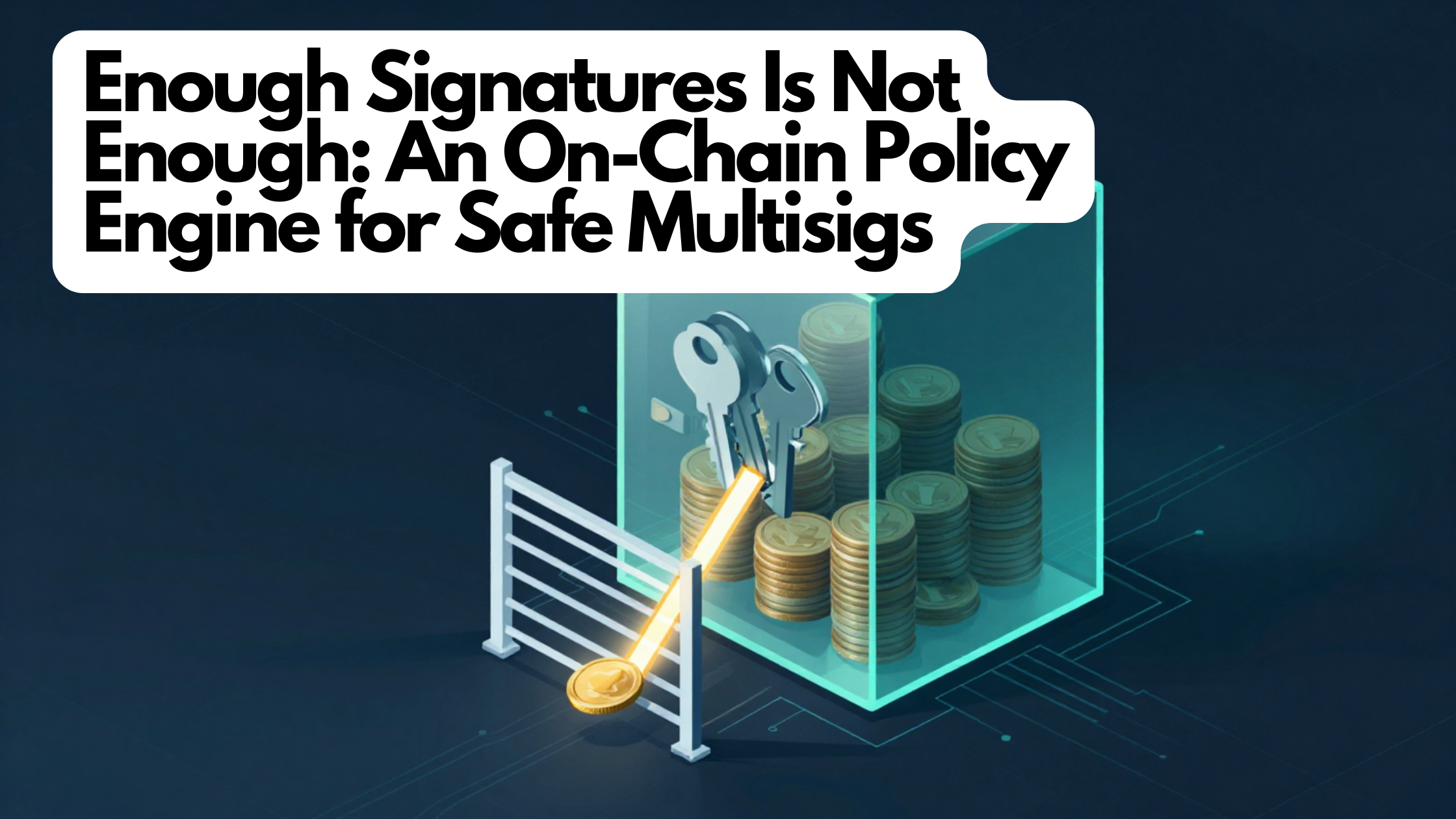
Part 1 covered FairWins’ shared vaults: a group holds a multisig with a propose-and-approve queue. This post adds the missing layer — a policy engine that constrains what an already-approved transaction may do, after the threshold is met but before the money moves. The phished proposal above dies at that final step against a per-transaction limit or a recipient allowlist, no matter how many signatures it collected.

The interesting question is where such rules can live so they’re actually binding. Checks inside the app are only advisory — anyone can talk to the multisig directly. A rules service on a company server is just another party you have to trust. The place that actually works is a transaction guard: a contract the multisig itself consults, on-chain, before every execution.

Where the guard sits

A modern Safe multisig can register a guard contract with a veto over every transaction. Just before executing an approved transaction, the Safe hands the guard the full details; if the guard objects, the transaction never runs.

FairWins’ guard is a single shared contract per network: one immutable contract holds the rule settings and running totals for every vault that has opted in, filed under each vault’s address. Because the multisig itself is the one asking, the guard always knows which vault’s rules to apply — no setup handshake needed.

Two properties define the trust model. First, the guard is restriction-only: it can block a transaction but never start, approve, or execute one, and it holds no money. Second, a vault is the only authority over its own rules: changing a vault’s policy is itself a transaction that must clear that vault’s normal approval threshold. There is no owner, no admin role, and the guard is deliberately not upgradeable — an upgrade key over it would be a master backdoor over every vault’s enforcement.

The rules

Version 1 ships the classic treasury controls, each independently switchable per vault:

  • Per-transaction limit — per asset; no single outgoing transaction may exceed it.
  • Daily limit — per asset, over a rolling 24-hour window.
  • Recipient allowlist — outgoing money may only go to pre-approved addresses.
  • Cooldown — a minimum wait between money-moving transactions.

A transaction “counts” against these limits when it moves value — sending the native coin, or one of the standard token operations the guard recognizes: transfer, transfer-on-behalf-of, and approve. Counting approve matters: approving a spender is a spending grant, and ignoring it would leave an obvious loophole where the vault grants an unlimited allowance and the spender quietly drains it later.

The allowlist has a subtlety worth copying. For token movements it checks the beneficiary — whoever ultimately receives or can pull the tokens — not just the token contract being called. For everything else it checks the direct target, so even a transaction the guard can’t fully interpret still can’t reach an un-approved contract. A locked-down vault genuinely stays locked down.

Closing the escape hatches first

Limits are worthless if a transaction can step outside the accounting entirely. So while any rule is active, the guard flatly rejects two dangerous shapes:

  • Code that runs inside the vault’s own context. One transaction type lets external code execute with the vault’s full authority — it could move funds without tripping any rule, or even rewrite the guard’s own settings. Refused outright. (The cost is that a certain batching trick isn’t available on rule-governed vaults; since these flows are single-action anyway, nothing is lost.)
  • Gas-refund transactions. The multisig can be told to reimburse the submitter’s gas out of vault funds — an outflow the limits wouldn’t otherwise see. Refused too.

Both rejections come back as clear, named errors, so the app can explain exactly why something was blocked instead of guessing at a cryptic failure.

You can always loosen the rules

The classic failure mode of on-chain rules is locking yourself in: owners set a cooldown of a year, or turn on an allowlist whose only address is now defunct, and the vault is bricked. The fix is a simple, deliberate carve-out. Two kinds of transaction skip all the spending rules entirely: managing the vault itself (owners, threshold, the guard), and changing the vault’s own policy. Both still require the vault’s normal approval threshold — so the only thing exempt is the collective ability to change the rules.

The result: a too-strict policy can always be loosened by the same group consent that set it, and no vault can ever be locked out by its own rules. This isn’t just asserted — it’s tested against a real multisig deployment, not a stand-in mock.

What you see is what gets enforced

Owners should learn a transaction breaks policy before they spend approvals on it. The guard offers a read-only preview that runs the exact same rule check the real enforcement uses, and the app runs every proposal through it first — so what the interface warns you about can never drift from what the chain enforces. Enforcement itself is careful about ordering: the guard reads and evaluates first, then records the updated totals, and never calls out to another contract, so there’s no room for the reentrancy trickery that plagues contracts that move money.

Rules from the very first transaction

A guard attached after creation leaves a window where early transactions are unpoliced. So FairWins can wire the guard in during vault creation itself: the guard address and starting rules are part of the setup, baked into the vault’s predicted address, and if any part of that setup fails the whole creation is aborted — a half-configured vault can never come into existence. For an existing vault, attachment is ordered so there’s never a moment where the guard is half-on.

Design decisions and accepted limits

Immutable, not upgradeable — on purpose. Elsewhere FairWins leans on upgradeable contracts, but the guard has no upgrade path by design: whoever could swap it out could disable every vault’s enforcement. Improvements ship as a brand-new guard that each vault chooses to adopt through its own approval — consent per vault, never a decision imposed by a single deploy key.

Fixed daily window, not perfectly rolling. A truly continuous rolling window would require storing unbounded transaction history on-chain. The simpler fixed-reset window can, in a worst case straddling a reset, allow up to twice the limit — a small, bounded weakening that’s disclosed in the interface rather than hidden.

Uninterpreted transactions pass the spending limits. The guard values native transfers and the standard token operations; something exotic like a DEX swap passes the spending limits unmeasured. It still faces the allowlist on its target — so a vault that needs a hard lockdown turns on the allowlist and gets one.

Conservative accounting. Totals are recorded before the transaction executes. If the inner action later fails quietly, the spend still counts. Overcounting can only ever restrict, never over-permit — the safe direction to err.

The through-line: every rule that exists is enforced exactly, every gap that exists is named, bounded, and disclosed, and no key anywhere can quietly waive either.

Further reading

Sponsored Gas Without a Vendor: How “No Network Fee” Became True

How FairWins made “no network fee” an honest promise — by quietly covering the fee itself, using infrastructure it already ran

The lie in the confirm screen

A member creates a FairWins passkey account, receives 40 USDC from a friend, and tries to send 10 of it onward. The confirm screen says “Gasless · sponsored — no network fee.” They tap confirm with their fingerprint. The transfer fails.

Here’s why. Every blockchain transaction costs a small network fee, paid in the chain’s own native token — not in the stablecoin the member actually holds. This account had 40 USDC and zero native token, so there was nothing to pay the fee with, and the transaction was rejected. It’s worse on a member’s very first action, which also has to pay to deploy their account on-chain — so during a busy period even an account holding some native token could come up short.

In other words, the product had promised “sponsored” before the machinery to sponsor anything existed. That broke a standing FairWins principle: the interface must never claim something that isn’t true. There were two ways to fix it — change the words, or make them true. FairWins chose to make them true, with one firm constraint: no third-party sponsorship service. The company already ran the plumbing that submits these gasless transactions and the gateway that screens them, so sponsorship had to be built from those parts.

This post walks through what that took: a deliberately tiny “paymaster” contract, an approval service bolted onto the gateway FairWins already ran, a securely held signing key, and — because nobody may ever be stranded — a fallback that keeps every member able to act even when sponsorship is down.

What sponsoring a fee actually means

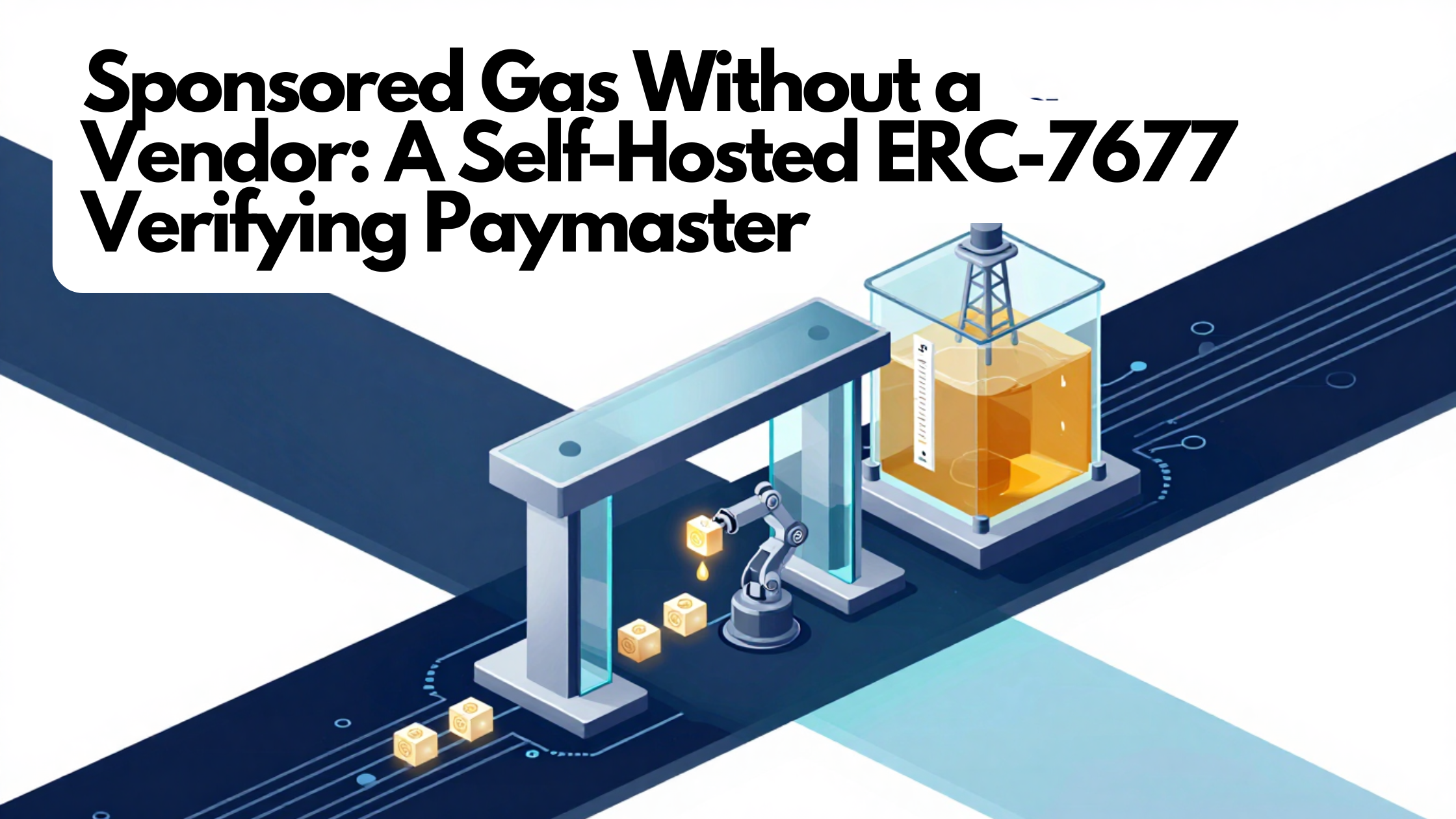
The smart-account standard these wallets use lets a transaction name a paymaster: a contract that tells the network, “I’ll cover the fee for this one.” The network then charges the fee to the paymaster’s pre-funded balance instead of the user’s. The entire design question is how the paymaster decides which transactions to pay for.

verifying paymaster answers that with a signature. An off-chain service looks at each transaction and, if it approves, signs a stamp of approval tied to that exact transaction. The contract’s only on-chain job is to check the stamp is genuine — signed by the one authorized signer — and, if so, cover the fee.

The FairWins paymaster is intentionally minimal: its approval stamp is bound to the specific transaction — its sender, its exact contents, the fee ceiling, the network, the paymaster’s own address, and a short expiry window. Because the stamp is nailed to all of that, an approval can’t be reused on a different transaction, on a different network, or after it expires. And it needs no memory of past transactions: the account’s own built-in transaction counter already makes each one single-use. A contract that checks a signature and stores no state is the simplest and safest kind, and stays portable to other networks later.

The economics are just as simple. The paymaster holds a pre-funded deposit with the network, and that deposit is both the sponsorship pool and the hard cap on how much can ever be lost. When the network runs a sponsored transaction, it draws the fee from that deposit — FairWins paying its own gas back, one transaction at a time, all accounted for on-chain.

The decision half: an approval service on the gateway FairWins already ran

The approval signature has to come from somewhere, and where is the real policy decision. There’s an open standard for exactly this handshake — how a wallet asks a sponsorship service for approval — with two steps: a dummy approval so the wallet can estimate the transaction size, then the real, signed one. Because the FairWins frontend already builds transactions with standard tooling, adopting it made the client-side work nearly free.

Rather than stand up a whole new service, FairWins added a sponsorship route to the gateway that already fronts its other gasless features. That gateway already had the three controls sponsorship needs, and the new route reuses them instead of reinventing them:

  1. A kill switch — one setting halts all sponsorship instantly; clients quietly fall back to paying their own fee.
  2. Sanctions screening — the account is checked against sanctions lists, and it fails closed: if it can’t be screened, it isn’t sponsored.
  3. Quotas — per-account and platform-wide rate limits, so no one account and no single day can drain the pool.

Two extra ceilings are new, because sponsorship spends real money on every transaction: a sanity limit on transaction size and a worst-case cost cap, so a single deliberately expensive transaction can’t burn a big slice of the deposit. Every refusal happens before anything is signed, so a rejected request costs the operator nothing.

That signature comes from a securely managed cloud key service — the gateway never holds the raw signing key. Critically, the gateway refuses to start if its signing key doesn’t match the signer the on-chain contract expects. A mismatch that would otherwise silently break every sponsorship instead fails loudly at deploy time, where someone will notice.

One discipline is worth calling out: the “stamp” being signed is computed in two separate codebases — the contract and the gateway — and they must produce byte-for-byte identical results, or every sponsored transaction fails. A cross-check test deploys the real contract and asserts the two agree.

Never stranded, never dishonest

Sponsorship is a nice-to-have, and the platform rule is that a nice-to-have must never strand a member. So the app treats every failure to get sponsorship — service down, kill switch on, quota hit, screening refusal, network blip — identically: rebuild the transaction to pay its own fee and quietly retry once.

There’s a subtle trap the code is careful about. If a transaction would fail on its own merits — say, sending more than the account holds — that’s not a sponsorship failure and must not be silently retried, because the retry would fail identically and hide the real reason. So the fallback only kicks in for genuine sponsorship or network failures.

The disclosure follows the same honesty rule that created this feature. The system tracks a single fact: was this transaction actually sponsored? The confirm screen renders straight from it — “Gasless — no network fee” when true, “You pay the network fee” when false, including the exact shortfall when the account can’t cover it. The rule that the words must match reality is built into the mechanism, not left to good intentions.

Why we built it this way

Sponsor the fee, don’t charge it in stablecoin. An alternative was a paymaster that quietly takes a little USDC to cover the fee — but that needs price feeds, extra accounting, and an approval step, all for an outcome where the member still pays. Sponsoring is the smallest pattern and the only one that makes “no network fee” literally true.

Self-hosted, eyes open. Refusing outside vendors costs real work — key management, quota design, watching the runway — and buys independence: no vendor lock-in, no per-transaction markup, and every policy decision enforced in FairWins’ own gateway.

A small, bounded blast radius. If the approval-signing key were ever stolen, the thief could approve sponsorships — wasting the deposit on other people’s fees — but could not withdraw a cent: withdrawal is restricted to a separate owner key kept in offline, air-gapped storage. The worst case is capped at the deposit, throttled by quotas, cut off by the kill switch, and cleaned up by rotating to a new signer. Keeping the deposit deliberately small keeps that worst case small by policy, not by hope.

Open to everyone. Sponsorship isn’t reserved for higher membership tiers. Any passkey account that passes screening and stays within quota qualifies — spend is bounded by the ceilings, the pool, and the kill switch, not by narrowing who benefits.

The result: when the confirm screen says “no network fee,” it’s telling the truth — the app quietly covered it — and when it can’t, it says so plainly.

Further reading